November 13, 2026: The Day the System Failed
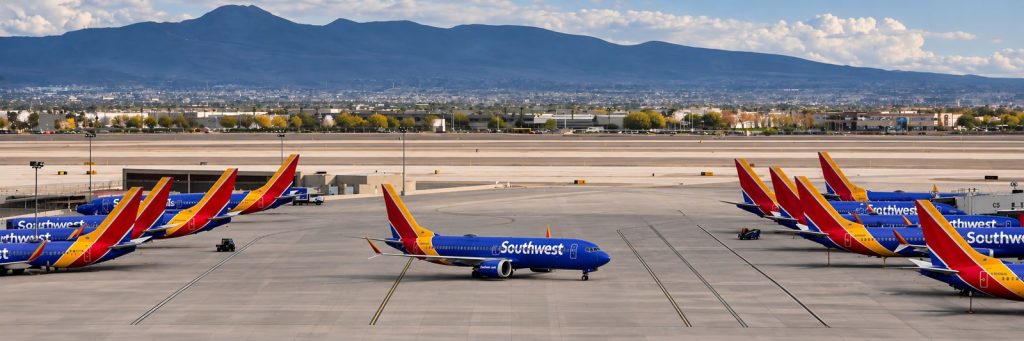
FAA “ground stop” at Harry Reid International Airport, Las Vegas following air traffic control collapse. AI-generated illustration based on an Associated Press photograph by John Locher, November 13, 2026.
On Friday, November 13, 2026, the United States government ordered a nationwide ground stop of commercial aircraft departures lasting more than four hours, exposing the extraordinary dependence of the American economy and the traveling public upon the ability of the federal government to provide air traffic control and manage American airspace.
While aviation and telecommunications have undergone a technological revolution during the past half-century, the organization responsible for managing American airspace remains fragmented among federal agencies operating within an administrative structure inherited from an earlier era.
Congress must stop treating the recurring crises of American air traffic control as isolated emergencies requiring additional appropriations and begin the fundamental reorganization of the system itself.
The 1981 Crisis
In August 1981, President Ronald Reagan dismissed approximately 11,400 striking air traffic controllers, depriving the system of an experienced professional workforce whose practical judgment, situational awareness, and ability to anticipate developing hazards could not be readily replaced.
The controllers had been engaged in a prolonged dispute with the federal government over compensation, working hours, and conditions of employment, including the extraordinary psychological demands of maintaining the safe separation of aircraft within an increasingly strained technological environment.
The government concentrated on keeping aircraft flying rather than undertaking the fundamental institutional and technological reforms the system required. Successive administrations continued that approach, responding to shortages, breakdowns, and emergencies without reorganizing the national air traffic control system to meet the demands of modern aviation.
A Technological Revolution Left Behind
During the past half-century, satellite communications, global positioning systems, high-capacity digital networks, and computers capable of processing enormous quantities of information have transformed aviation and telecommunications.
Modern commercial aircraft carry sophisticated navigation systems, transponders, satellite-based positioning equipment, and onboard computers capable of continuously determining their location, altitude, speed, and direction. The technology necessary to maintain a continuously updated digital representation of aircraft movements throughout American airspace already exists.
While the Federal Aviation Administration has incorporated some of these advances into its air traffic control operations, modern digital systems continue to operate alongside aging infrastructure and legacy telecommunications, creating a patchwork of technologies that has resisted comprehensive modernization.
The United States possesses the technological resources to create a fully integrated national air traffic management system. What it lacks is the unified governmental organization capable of bringing those resources together.
Three Departments, One Airspace, No Unified Command
An aircraft traveling from New York to Los Angeles passes through one national airspace. Yet responsibility for managing that airspace is divided among three federal departments.
The Federal Aviation Administration operates within the Department of Transportation; the National Weather Service, part of the National Oceanic and Atmospheric Administration, operates within the Department of Commerce; and military aviation operates principally under the Department of Defense.
Each possesses professional personnel, sophisticated technology, and specialized knowledge essential to aviation safety. Yet their capabilities remain divided among separate administrative hierarchies, budgets, procurement systems, and institutional priorities.
American airspace is one national resource. Its management must become one national responsibility.
An Air Travel Administration Within the Department of Defense
Congress should establish an Air Travel Administration within the Department of Defense (DOD), operating as a separately administered, civilian-led organization responsible for the integrated management of American airspace.
The new Air Travel Administration would consolidate civilian air traffic management, aviation meteorology, and coordination with military aviation under a single accountable civilian administrator, with authority over aircraft tracking, communications, navigation, procurement, and continuous technological modernization.
Over decades of managing military aviation and national defense systems, DOD has developed extensive expertise in satellite communications, secure digital networks, surveillance, navigation, and the integration of information from widely dispersed operational facilities. Its experience developing, acquiring, operating, and maintaining complex technological systems should be brought to bear on civilian air traffic management.
The civilian administrator would direct national air traffic operations and modernization, with civilian aviation safety remaining paramount and independent safety oversight preserved. DOD would supply the technological resources and administrative support necessary to develop and maintain a unified national air traffic management system.
The purpose is not to create another layer of federal bureaucracy but to replace fragmented authority with a single organization responsible for the safe, efficient, and continuous management of American airspace.
Congress Must Stop Financing Failure
Replacing obsolete equipment without reorganizing the institutions responsible for operating it cannot produce the integrated national air traffic management system modern aviation requires. New technology installed within an obsolete administrative structure merely perpetuates the fragmentation that has prevented comprehensive modernization.
Congress must make institutional reorganization the foundation of future air traffic control appropriations. The proposed Air Travel Administration should receive the authority, resources, and responsibility to develop and implement a comprehensive national modernization program, with measurable objectives, enforceable deadlines, and direct accountability for results.
Essential air traffic operations must continue without interruption. But Congress should no longer finance successive modernization programs without first establishing the unified organization responsible for carrying them out.
November 13 Must Become a Turning Point
The events of November 13, 2026, should mark the end of the decades-long practice of responding to crises in American air traffic control with temporary measures and additional appropriations.
The United States has the technological capabilities, professional expertise, and financial resources to maintain the most advanced air traffic management system in the world. What it lacks is an Air Travel Administration with sufficient authority to bring those resources together.
Congress must establish an Air Travel Administration before the next crisis demonstrates, once again, the consequences of its failure to act.
Air Traffic Control: No Unified Command
November 14, 2026 | Public Policy
November 13, 2026: The Day the System Failed
FAA “ground stop” at Harry Reid International Airport, Las Vegas following air traffic control collapse. AI-generated illustration based on an Associated Press photograph by John Locher, November 13, 2026.
On Friday, November 13, 2026, the United States government ordered a nationwide ground stop of commercial aircraft departures lasting more than four hours, exposing the extraordinary dependence of the American economy and the traveling public upon the ability of the federal government to provide air traffic control and manage American airspace.
While aviation and telecommunications have undergone a technological revolution during the past half-century, the organization responsible for managing American airspace remains fragmented among federal agencies operating within an administrative structure inherited from an earlier era.
Congress must stop treating the recurring crises of American air traffic control as isolated emergencies requiring additional appropriations and begin the fundamental reorganization of the system itself.
The 1981 Crisis
In August 1981, President Ronald Reagan dismissed approximately 11,400 striking air traffic controllers, depriving the system of an experienced professional workforce whose practical judgment, situational awareness, and ability to anticipate developing hazards could not be readily replaced.
The controllers had been engaged in a prolonged dispute with the federal government over compensation, working hours, and conditions of employment, including the extraordinary psychological demands of maintaining the safe separation of aircraft within an increasingly strained technological environment.
The government concentrated on keeping aircraft flying rather than undertaking the fundamental institutional and technological reforms the system required. Successive administrations continued that approach, responding to shortages, breakdowns, and emergencies without reorganizing the national air traffic control system to meet the demands of modern aviation.
A Technological Revolution Left Behind
During the past half-century, satellite communications, global positioning systems, high-capacity digital networks, and computers capable of processing enormous quantities of information have transformed aviation and telecommunications.
Modern commercial aircraft carry sophisticated navigation systems, transponders, satellite-based positioning equipment, and onboard computers capable of continuously determining their location, altitude, speed, and direction. The technology necessary to maintain a continuously updated digital representation of aircraft movements throughout American airspace already exists.
While the Federal Aviation Administration has incorporated some of these advances into its air traffic control operations, modern digital systems continue to operate alongside aging infrastructure and legacy telecommunications, creating a patchwork of technologies that has resisted comprehensive modernization.
The United States possesses the technological resources to create a fully integrated national air traffic management system. What it lacks is the unified governmental organization capable of bringing those resources together.
Three Departments, One Airspace, No Unified Command
An aircraft traveling from New York to Los Angeles passes through one national airspace. Yet responsibility for managing that airspace is divided among three federal departments.
The Federal Aviation Administration operates within the Department of Transportation; the National Weather Service, part of the National Oceanic and Atmospheric Administration, operates within the Department of Commerce; and military aviation operates principally under the Department of Defense.
Each possesses professional personnel, sophisticated technology, and specialized knowledge essential to aviation safety. Yet their capabilities remain divided among separate administrative hierarchies, budgets, procurement systems, and institutional priorities.
American airspace is one national resource. Its management must become one national responsibility.
An Air Travel Administration Within the Department of Defense
Congress should establish an Air Travel Administration within the Department of Defense (DOD), operating as a separately administered, civilian-led organization responsible for the integrated management of American airspace.
The new Air Travel Administration would consolidate civilian air traffic management, aviation meteorology, and coordination with military aviation under a single accountable civilian administrator, with authority over aircraft tracking, communications, navigation, procurement, and continuous technological modernization.
Over decades of managing military aviation and national defense systems, DOD has developed extensive expertise in satellite communications, secure digital networks, surveillance, navigation, and the integration of information from widely dispersed operational facilities. Its experience developing, acquiring, operating, and maintaining complex technological systems should be brought to bear on civilian air traffic management.
The civilian administrator would direct national air traffic operations and modernization, with civilian aviation safety remaining paramount and independent safety oversight preserved. DOD would supply the technological resources and administrative support necessary to develop and maintain a unified national air traffic management system.
The purpose is not to create another layer of federal bureaucracy but to replace fragmented authority with a single organization responsible for the safe, efficient, and continuous management of American airspace.
Congress Must Stop Financing Failure
Replacing obsolete equipment without reorganizing the institutions responsible for operating it cannot produce the integrated national air traffic management system modern aviation requires. New technology installed within an obsolete administrative structure merely perpetuates the fragmentation that has prevented comprehensive modernization.
Congress must make institutional reorganization the foundation of future air traffic control appropriations. The proposed Air Travel Administration should receive the authority, resources, and responsibility to develop and implement a comprehensive national modernization program, with measurable objectives, enforceable deadlines, and direct accountability for results.
Essential air traffic operations must continue without interruption. But Congress should no longer finance successive modernization programs without first establishing the unified organization responsible for carrying them out.
November 13 Must Become a Turning Point
The events of November 13, 2026, should mark the end of the decades-long practice of responding to crises in American air traffic control with temporary measures and additional appropriations.
The United States has the technological capabilities, professional expertise, and financial resources to maintain the most advanced air traffic management system in the world. What it lacks is an Air Travel Administration with sufficient authority to bring those resources together.
Congress must establish an Air Travel Administration before the next crisis demonstrates, once again, the consequences of its failure to act.