ChatGPT is changing the practice of law.
Artificial intelligence in litigation can save many hours of time for the lawyers involved and reduce their need for junior associates, paralegals, clerks and word processors. ChatGPT can analyze pleadings, affidavits, exhibits, correspondence, account records, discovery responses, judicial decisions, statutes, court rules and transcripts according to the objectives of the attorneys prosecuting or defending the lawsuit. An AI agent using ChatGPT can analyze hundreds, even thousands, of pages and organize them around the issues in the case, compare a complaint with an answer, claims with affirmative defenses and counterclaims, and allegations with the evidence that may support them. The AI agent can identify matters that deserve further investigation, suggest discovery, locate and compare cases, develop arguments, draft documents, criticize its own drafts, and find weaknesses in my case before my adversary does. But that is only the beginning.
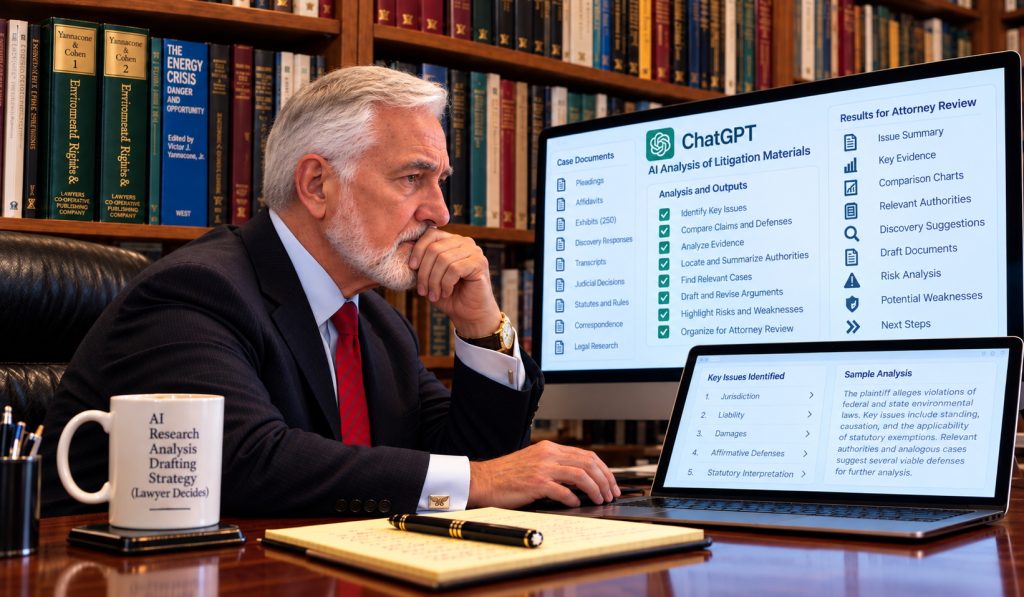
Artificial intelligence can analyze litigation materials, organize issues and evidence, locate authorities for attorney review.As AI agents become more capable, Lexis, Westlaw, court websites, statutes, reporters, and other specialized legal sources will become elements of a larger AI-assisted research process, and AI agents will increasingly become the organizing work center for attorneys. But never forget that an AI agent can be wrong. It can find the wrong case, misinterpret the right one, misstate a holding, invent a quotation, confuse an allegation with a fact, or reach a perfectly logical conclusion from a factual premise that is completely wrong. Worse, it can do all of this as part of a convincing conversation. The greatest danger is not an obvious mistake. It is a mistake that fits comfortably into your theory of the case.
Using Artificial Intelligence in Litigation
There is no acceptable way to delegate the management of litigation to an AI agent without creating an unacceptable risk of malpractice.
The interaction between a trial lawyer and an AI assistant must begin with the lawyer defining the case, supplying the available materials, and establishing what the AI agent is being asked to do.
Before initiating a ChatGPT conversation about pending litigation, the lawyer must assemble all the pleadings, affidavits, exhibits, correspondence, account records, discovery responses, transcripts, judicial decisions, statutes, court rules, photographs, or other materials relevant to the litigation, whatever they are and however they were obtained. Then the lawyer prepares the initial prompt telling the AI agent who the lawyer represents and whether the client is the plaintiff, defendant, an intervening party, a third party, or another participant. The attorney concludes the prompt by directing the AI agent to analyze all of the materials provided and produce a list of recommended actions with a detailed explanation supporting each recommendation.
Then the lawyer sends the prompt. That marks the dividing line. Everything to that point is controlled by the lawyer. The AI agent has not yet supplied an analysis, recommended an action, introduced an outside source, or generated a factual or legal conclusion.
The AI agent response to that initial prompt provides the lawyer with an analysis of the materials provided, together with recommended actions and the reasons supporting those recommendations. Those recommendations are proposals to be evaluated by the lawyer, who decides which deserve further consideration. Some may require additional facts. Some may require additional documents or discovery. Others may require legal research beyond the authorities originally provided. As that work proceeds, information may enter the conversation that was not among the materials originally supplied by the lawyer.
That distinction is important. The lawyer knows the origin of the materials originally provided. Anything subsequently introduced through research or further analysis has a different provenance and must be treated accordingly.
Controlling and Verifying the AI Agent’s Work
Trial lawyers do not approach a case as disinterested observers. They represent a client, develop a theory of the case, advocate a position, and seek a particular result. ChatGPT can build an impressive structure around any theory that is logical, persuasive, and wrong. A mistaken premise can affect the characterization of evidence, shape the research, and eventually emerge as a polished legal argument that is still wrong. That danger led me to develop an AI-Assisted Litigation Control and Verification Protocol.
The control and verification process begins with what the lawyer knows. The lawyer must distinguish among the materials provided to the AI agent, information derived from those materials, and information subsequently introduced through additional research or analysis. The lawyer must also know where the original materials came from, what position was stated in the initial prompt, and what the AI agent was directed to do.
Factual assertions derived from the materials provided must be checked against original materials. Dates, amounts, quotations, testimony, exhibits and other significant facts must be confirmed in the record. A conclusion based upon a factual premise must be examined to determine whether the premise itself is supported by the record.
Cases, statutes, rules, orders and other authorities introduced during research require a different verification. The lawyer must determine that the authority exists, examine the original source, verify quotations and citations, determine whether a judicial decision actually supports the proposition for which it is cited, and determine whether the authority remains applicable.
The same process applies to the AI agent’s recommended actions and the arguments that develop from them. The lawyer decides what to investigate, what additional research to undertake, what recommendations to reject or modify, what arguments to make, and ultimately what will be presented to the court.
The Control and Verification Protocol must leave the lawyer able to identify the materials provided to the AI agent, the instructions given, the sources introduced during the analysis, what was independently verified, what was rejected or changed, and what decisions were made. If the court questions the source of the facts or law, the verification of the authorities and evidence, the choice of arguments, the exercise of legal judgment, or the decision about what was presented to the court, the answer must always lead back to the lawyer. Whatever assistance the AI agent provided, responsibility for what is presented to the court remains with the lawyer.
That is the distinction between using an AI agent in the practice of law and allowing an AI agent to practice law.
The Future of Artificial Intelligence in Litigation
AI agents will become faster, more capable, and more deeply integrated into the litigation process. Attorneys who know how to use them will examine more evidence, conduct broader research, test more theories, and accomplish more work in less time and with less support. More of the work once performed by associates, law clerks, paralegals, and other human support staff will be accomplished by use of AI agents.
Artificial intelligence will change how lawyers practice law. It should not change who practices law.
The next article, Are Two Artificial Intelligence Agents Better in Litigation?, explains how using a second, independent AI agent provides an additional means of testing the analysis, research, and conclusions produced during AI-assisted litigation, thereby improving reliability.
Permission to Repost. You may reproduce this article in its entirety on social media, blogs, and other websites without requesting additional permission, provided the article is reproduced in full without alteration, identifies Victor John Yannacone, Jr. as the author, and includes a prominent link to the original article on this website.
Artificial Intelligence in Litigation Without Letting It Practice Law
August 31, 2026 | AI in litigation
ChatGPT is changing the practice of law.
Artificial intelligence in litigation can save many hours of time for the lawyers involved and reduce their need for junior associates, paralegals, clerks and word processors. ChatGPT can analyze pleadings, affidavits, exhibits, correspondence, account records, discovery responses, judicial decisions, statutes, court rules and transcripts according to the objectives of the attorneys prosecuting or defending the lawsuit. An AI agent using ChatGPT can analyze hundreds, even thousands, of pages and organize them around the issues in the case, compare a complaint with an answer, claims with affirmative defenses and counterclaims, and allegations with the evidence that may support them. The AI agent can identify matters that deserve further investigation, suggest discovery, locate and compare cases, develop arguments, draft documents, criticize its own drafts, and find weaknesses in my case before my adversary does. But that is only the beginning.
Artificial intelligence can analyze litigation materials, organize issues and evidence, locate authorities for attorney review.As AI agents become more capable, Lexis, Westlaw, court websites, statutes, reporters, and other specialized legal sources will become elements of a larger AI-assisted research process, and AI agents will increasingly become the organizing work center for attorneys. But never forget that an AI agent can be wrong. It can find the wrong case, misinterpret the right one, misstate a holding, invent a quotation, confuse an allegation with a fact, or reach a perfectly logical conclusion from a factual premise that is completely wrong. Worse, it can do all of this as part of a convincing conversation. The greatest danger is not an obvious mistake. It is a mistake that fits comfortably into your theory of the case.
Using Artificial Intelligence in Litigation
There is no acceptable way to delegate the management of litigation to an AI agent without creating an unacceptable risk of malpractice.
The interaction between a trial lawyer and an AI assistant must begin with the lawyer defining the case, supplying the available materials, and establishing what the AI agent is being asked to do.
Before initiating a ChatGPT conversation about pending litigation, the lawyer must assemble all the pleadings, affidavits, exhibits, correspondence, account records, discovery responses, transcripts, judicial decisions, statutes, court rules, photographs, or other materials relevant to the litigation, whatever they are and however they were obtained. Then the lawyer prepares the initial prompt telling the AI agent who the lawyer represents and whether the client is the plaintiff, defendant, an intervening party, a third party, or another participant. The attorney concludes the prompt by directing the AI agent to analyze all of the materials provided and produce a list of recommended actions with a detailed explanation supporting each recommendation.
Then the lawyer sends the prompt. That marks the dividing line. Everything to that point is controlled by the lawyer. The AI agent has not yet supplied an analysis, recommended an action, introduced an outside source, or generated a factual or legal conclusion.
The AI agent response to that initial prompt provides the lawyer with an analysis of the materials provided, together with recommended actions and the reasons supporting those recommendations. Those recommendations are proposals to be evaluated by the lawyer, who decides which deserve further consideration. Some may require additional facts. Some may require additional documents or discovery. Others may require legal research beyond the authorities originally provided. As that work proceeds, information may enter the conversation that was not among the materials originally supplied by the lawyer.
That distinction is important. The lawyer knows the origin of the materials originally provided. Anything subsequently introduced through research or further analysis has a different provenance and must be treated accordingly.
Controlling and Verifying the AI Agent’s Work
Trial lawyers do not approach a case as disinterested observers. They represent a client, develop a theory of the case, advocate a position, and seek a particular result. ChatGPT can build an impressive structure around any theory that is logical, persuasive, and wrong. A mistaken premise can affect the characterization of evidence, shape the research, and eventually emerge as a polished legal argument that is still wrong. That danger led me to develop an AI-Assisted Litigation Control and Verification Protocol.
The control and verification process begins with what the lawyer knows. The lawyer must distinguish among the materials provided to the AI agent, information derived from those materials, and information subsequently introduced through additional research or analysis. The lawyer must also know where the original materials came from, what position was stated in the initial prompt, and what the AI agent was directed to do.
Factual assertions derived from the materials provided must be checked against original materials. Dates, amounts, quotations, testimony, exhibits and other significant facts must be confirmed in the record. A conclusion based upon a factual premise must be examined to determine whether the premise itself is supported by the record.
Cases, statutes, rules, orders and other authorities introduced during research require a different verification. The lawyer must determine that the authority exists, examine the original source, verify quotations and citations, determine whether a judicial decision actually supports the proposition for which it is cited, and determine whether the authority remains applicable.
The same process applies to the AI agent’s recommended actions and the arguments that develop from them. The lawyer decides what to investigate, what additional research to undertake, what recommendations to reject or modify, what arguments to make, and ultimately what will be presented to the court.
The Control and Verification Protocol must leave the lawyer able to identify the materials provided to the AI agent, the instructions given, the sources introduced during the analysis, what was independently verified, what was rejected or changed, and what decisions were made. If the court questions the source of the facts or law, the verification of the authorities and evidence, the choice of arguments, the exercise of legal judgment, or the decision about what was presented to the court, the answer must always lead back to the lawyer. Whatever assistance the AI agent provided, responsibility for what is presented to the court remains with the lawyer.
That is the distinction between using an AI agent in the practice of law and allowing an AI agent to practice law.
The Future of Artificial Intelligence in Litigation
AI agents will become faster, more capable, and more deeply integrated into the litigation process. Attorneys who know how to use them will examine more evidence, conduct broader research, test more theories, and accomplish more work in less time and with less support. More of the work once performed by associates, law clerks, paralegals, and other human support staff will be accomplished by use of AI agents.
Artificial intelligence will change how lawyers practice law. It should not change who practices law.
The next article, Are Two Artificial Intelligence Agents Better in Litigation?, explains how using a second, independent AI agent provides an additional means of testing the analysis, research, and conclusions produced during AI-assisted litigation, thereby improving reliability.
Permission to Repost. You may reproduce this article in its entirety on social media, blogs, and other websites without requesting additional permission, provided the article is reproduced in full without alteration, identifies Victor John Yannacone, Jr. as the author, and includes a prominent link to the original article on this website.