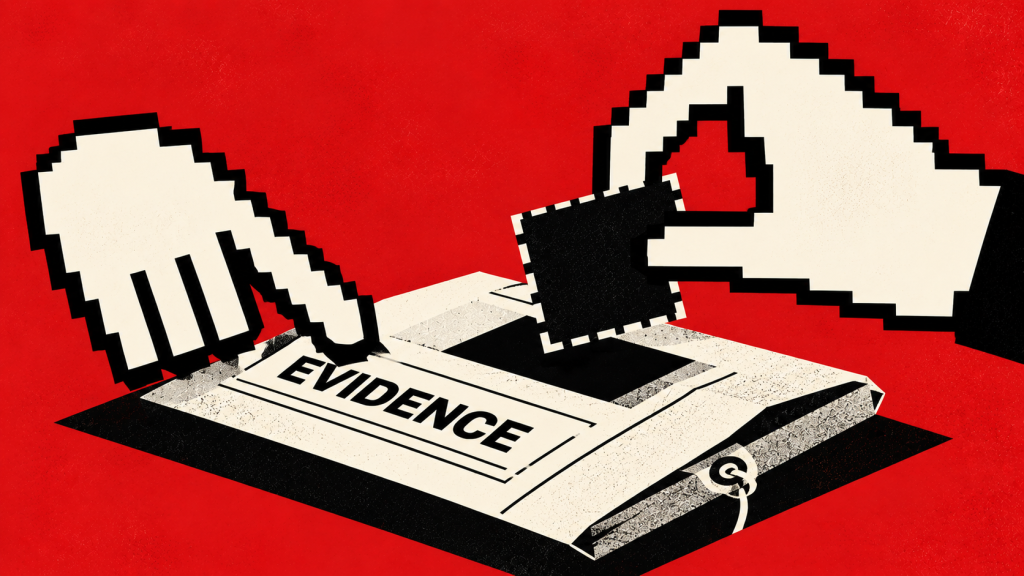
 Generative Artificial Intelligence in the Criminal Courtroom
For more than a century, photographs have occupied a special place in the courtroom. A witness can lie. A witness can be mistaken. Memory fades. Perception is imperfect. But a photograph seems different. We look at a photograph and instinctively believe that what we see is real. AI alteration of photographic evidence threatens that assumption.
Modern generative artificial intelligence can create a photorealistic image of an event that never occurred. Perhaps more dangerously, it can take an authentic photograph of an actual event and change one important fact while leaving everything else apparently untouched.
That presents a new problem for the administration of justice because sophisticated photographic manipulation no longer requires sophisticated photographic skills.
Photographs have been manipulated almost since photography was invented.
Programs such as Adobe Photoshop made sophisticated photographic alteration possible. But significant manipulation generally required some degree of technical skill.
Generative artificial intelligence has changed that. A person no longer needs comparable skill in photographic editing to make a sophisticated alteration. Simply tell the artificial-intelligence system what should be changed.
One Small Alteration Can Change the Evidence
Consider a homicide investigation.
Police officers arrive at the scene. A crime-scene photographer takes photographs of the room, the victim, the furniture, the blood, a firearm, and the other physical evidence. The photographs are genuine.
But someone can tell a generative artificial-intelligence system what the finished picture should depict. Move the firearm closer to the victim. Or move the victim’s hand. Or change the position of an evidence marker. Or change the size or shape of a bloodstain. Or remove an object inconsistent with the prosecution’s theory of the crime. Or add an object to the defendant’s hand. In the resulting photograph, the room is real. The body is real. The furniture is real. The blood is real. The photograph was actually taken by the police at the crime scene.
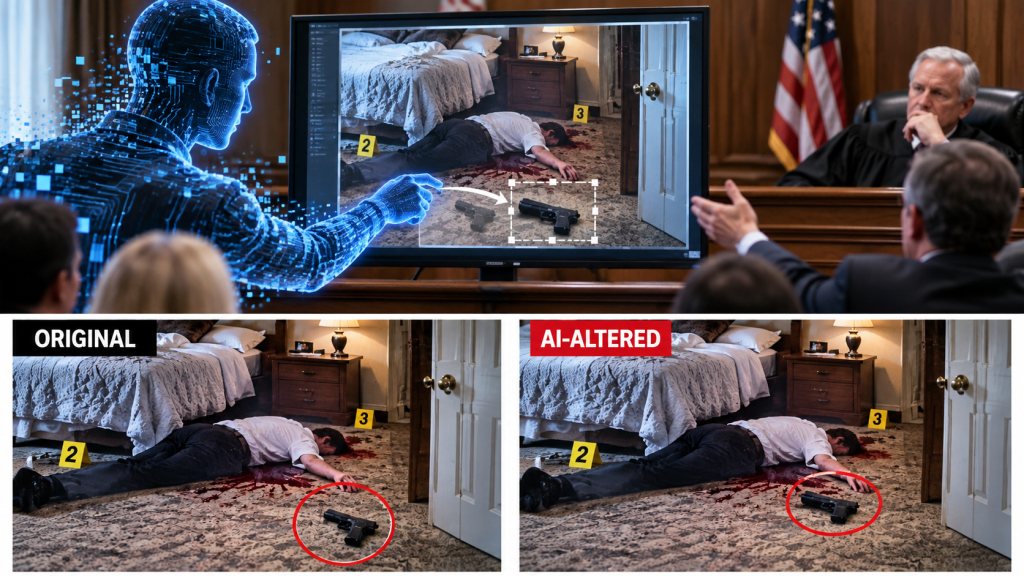
Ninety-nine percent of the photograph may be authentic. But the one percent that was altered may determine guilt or innocence.
What Does It Mean to Authenticate a Photograph?
Traditionally, photographs may be authenticated under Rule 901 of the Federal Rules of Evidence by someone with knowledge who testifies that the photograph fairly and accurately depicts what they observed.
Generative artificial intelligence requires us to ask whether the photograph depicts what the imaging device actually recorded when the photograph was taken.
A police officer may truthfully testify about taking the photograph at the crime scene. But the photograph being displayed to the jury may differ in one material respect from what the camera originally recorded.
Chain of Custody Is No Longer Enough
The criminal justice system has long used chain-of-custody procedures to protect the integrity of physical evidence.
When blood is collected, a firearm is recovered, or narcotics are seized, procedures exist to establish what was collected and to account for its subsequent handling.
Digital photographs require the same protection and something more.
Traditional chain of custody focuses on possession and handling. Possession has a very different meaning when the evidence is a digital photograph.
The critical question is whether the photograph being offered in evidence today contains the same evidentiary information recorded by the imaging device when the photograph was taken.
For digital photographic evidence, custody is no longer enough. We need a digital chain of authenticity.
Authentication Must Begin When the Photograph Is Taken
The essential technology already exists.
The National Institute of Standards and Technology (NIST) recommends hashing digital images as a best practice for the preservation of digital evidence. A cryptographic hash can function as a digital fingerprint for a file. Changing even one bit will ordinarily produce a different hash. NIST also recommends documenting the original source of a digital file and securing evidence files with access controls and logging.
In the age of generative artificial intelligence, we should go one step further.
The imaging devices used by law-enforcement agencies to create evidentiary photographs should cryptographically authenticate each image when the photograph is taken.
The original image and its authentication information should then be preserved. The authenticated original should never become the working copy.
If a detective enlarges a photograph, a laboratory technician adjusts its brightness, or a prosecutor crops it for presentation to the jury, the resulting image is a derivative. There is nothing inherently improper about any of those operations.
Every enhancement, adjustment, or other processing should be performed on a derivative copy. Every derivative image intended for evidentiary use should remain traceable to the authenticated original.
The prosecution should be able to demonstrate the history of the image. The defense should be entitled to examine it. And the court should be able to determine whether and how the image was modified between the time the photograph was taken and when it appears in the courtroom.
The Coalition for Content Provenance and Authenticity (C2PA) has developed technical specifications for recording verifiable information about the origin and history of digital content, commonly presented as Content Credentials. Content Credentials can be cryptographically bound to an image so that information about its creation and subsequent modification can be verified, and later tampering can be detected.
Proposed Rule 901(c) Addresses Artificial Intelligence
The Advisory Committee on Evidence Rules of the Judicial Conference of the United States has prepared, but has not finally approved, proposed Rule 901(c), dealing with evidence potentially fabricated by generative artificial intelligence.
The current working draft uses a two-stage procedure. The opponent would first have to present evidence sufficient to support a finding that the challenged item was fabricated by generative artificial intelligence. If that threshold were satisfied, the proponent would have to demonstrate to the court that the evidence is more likely than not authentic.
A requirement that the opponent first produce evidence suggesting fabrication presents a practical difficulty: the success of the alteration may prevent the opponent from discovering the evidence necessary to challenge it.
If the alteration is convincing enough, there may be nothing visible in the photograph to alert defense counsel that the photograph was altered.
There is a better place to begin protecting the integrity of the evidence. Begin when the photograph is taken.
Preventing AI Alteration of Photographic Evidence
For government-created photographic evidence, the prosecution should be required to establish a digital chain of authenticity from the creation of the photograph through its presentation in court.
That chain should establish that the photograph offered in evidence contains the same evidentiary information recorded by the imaging device when the photograph was taken. If a derivative image is offered, the prosecution should also establish its relationship to the authenticated original and disclose any material adjustment, enhancement, or processing.
The defense should have access to the authenticated original, the information necessary to verify its authenticity, and the relevant history of any derivative image the prosecution intends to offer in evidence.
Government-created photographic evidence for which the required digital chain of authenticity cannot be established should be excluded.
Government and Private Photographs Require Different Rules
Photographs created by law-enforcement agencies and photographs taken by private individuals present the same fundamental problem.
The image ultimately offered in evidence may not contain the same evidentiary information originally recorded by the camera.
The difference is that law-enforcement agencies can be required to use imaging devices that authenticate a photograph when it is taken.
Although a private individual who unexpectedly witnesses a crime cannot be expected to use a camera equipped to authenticate photographs, some cellphones are already capable of providing that kind of authentication.
Google’s Pixel 10 phones cryptographically sign photographs created by the Pixel Camera application and use hardware-protected security to provide information about the origin of the image.
Until authenticated imaging becomes a standard feature of consumer cameras and cellphones, privately created photographs will continue to be authenticated under existing rules governing photographic and digital evidence. The absence of capture-time authentication should not itself make a privately created photograph inadmissible.
Government-created photographic evidence must be treated differently. The government controls the equipment and the process. Technology capable of authenticating an image when it is taken already exists. The digital chain of authenticity for government-created evidence must begin when the photograph is taken.
Establishing Trust in Photographic Evidence
The criminal justice system has already adapted to the digital age. Documents are routinely filed in digital format. Communications have moved from letters to email and text messages. Enormous quantities of evidence now exist only in digital form.
Our criminal justice system must now adapt to a world in which an authentic photograph can be convincingly altered without sophisticated editing skills.
The widespread adoption of generative artificial intelligence means that our assumptions about photographs as evidence in criminal trials must change. The integrity of the photograph must be established when the photograph is taken.
For physical evidence, we developed the chain of custody. For photographic evidence in the age of generative artificial intelligence, we now need the digital chain of authenticity.
The principle is the same. The technology has changed. The law must recognize the difference.
Permission to Repost. You may reproduce this article in its entirety on social media, blogs, and other websites without requesting additional permission, provided the article is reproduced in full without alteration, identifies Victor John Yannacone, Jr. as the author, and includes a prominent link to the original article on this website.
Can You Still Believe a Photograph?
October 1, 2026 | AI in litigation
For more than a century, photographs have occupied a special place in the courtroom. A witness can lie. A witness can be mistaken. Memory fades. Perception is imperfect. But a photograph seems different. We look at a photograph and instinctively believe that what we see is real. AI alteration of photographic evidence threatens that assumption.
Modern generative artificial intelligence can create a photorealistic image of an event that never occurred. Perhaps more dangerously, it can take an authentic photograph of an actual event and change one important fact while leaving everything else apparently untouched.
That presents a new problem for the administration of justice because sophisticated photographic manipulation no longer requires sophisticated photographic skills.
Photographs have been manipulated almost since photography was invented.
Programs such as Adobe Photoshop made sophisticated photographic alteration possible. But significant manipulation generally required some degree of technical skill.
Generative artificial intelligence has changed that. A person no longer needs comparable skill in photographic editing to make a sophisticated alteration. Simply tell the artificial-intelligence system what should be changed.
One Small Alteration Can Change the Evidence
Consider a homicide investigation.
Police officers arrive at the scene. A crime-scene photographer takes photographs of the room, the victim, the furniture, the blood, a firearm, and the other physical evidence. The photographs are genuine.
But someone can tell a generative artificial-intelligence system what the finished picture should depict. Move the firearm closer to the victim. Or move the victim’s hand. Or change the position of an evidence marker. Or change the size or shape of a bloodstain. Or remove an object inconsistent with the prosecution’s theory of the crime. Or add an object to the defendant’s hand. In the resulting photograph, the room is real. The body is real. The furniture is real. The blood is real. The photograph was actually taken by the police at the crime scene.
Ninety-nine percent of the photograph may be authentic. But the one percent that was altered may determine guilt or innocence.
What Does It Mean to Authenticate a Photograph?
Traditionally, photographs may be authenticated under Rule 901 of the Federal Rules of Evidence by someone with knowledge who testifies that the photograph fairly and accurately depicts what they observed.
Generative artificial intelligence requires us to ask whether the photograph depicts what the imaging device actually recorded when the photograph was taken.
A police officer may truthfully testify about taking the photograph at the crime scene. But the photograph being displayed to the jury may differ in one material respect from what the camera originally recorded.
Chain of Custody Is No Longer Enough
The criminal justice system has long used chain-of-custody procedures to protect the integrity of physical evidence.
When blood is collected, a firearm is recovered, or narcotics are seized, procedures exist to establish what was collected and to account for its subsequent handling.
Digital photographs require the same protection and something more.
Traditional chain of custody focuses on possession and handling. Possession has a very different meaning when the evidence is a digital photograph.
The critical question is whether the photograph being offered in evidence today contains the same evidentiary information recorded by the imaging device when the photograph was taken.
For digital photographic evidence, custody is no longer enough. We need a digital chain of authenticity.
Authentication Must Begin When the Photograph Is Taken
The essential technology already exists.
The National Institute of Standards and Technology (NIST) recommends hashing digital images as a best practice for the preservation of digital evidence. A cryptographic hash can function as a digital fingerprint for a file. Changing even one bit will ordinarily produce a different hash. NIST also recommends documenting the original source of a digital file and securing evidence files with access controls and logging.
In the age of generative artificial intelligence, we should go one step further.
The imaging devices used by law-enforcement agencies to create evidentiary photographs should cryptographically authenticate each image when the photograph is taken.
The original image and its authentication information should then be preserved. The authenticated original should never become the working copy.
If a detective enlarges a photograph, a laboratory technician adjusts its brightness, or a prosecutor crops it for presentation to the jury, the resulting image is a derivative. There is nothing inherently improper about any of those operations.
Every enhancement, adjustment, or other processing should be performed on a derivative copy. Every derivative image intended for evidentiary use should remain traceable to the authenticated original.
The prosecution should be able to demonstrate the history of the image. The defense should be entitled to examine it. And the court should be able to determine whether and how the image was modified between the time the photograph was taken and when it appears in the courtroom.
The Coalition for Content Provenance and Authenticity (C2PA) has developed technical specifications for recording verifiable information about the origin and history of digital content, commonly presented as Content Credentials. Content Credentials can be cryptographically bound to an image so that information about its creation and subsequent modification can be verified, and later tampering can be detected.
Proposed Rule 901(c) Addresses Artificial Intelligence
The Advisory Committee on Evidence Rules of the Judicial Conference of the United States has prepared, but has not finally approved, proposed Rule 901(c), dealing with evidence potentially fabricated by generative artificial intelligence.
The current working draft uses a two-stage procedure. The opponent would first have to present evidence sufficient to support a finding that the challenged item was fabricated by generative artificial intelligence. If that threshold were satisfied, the proponent would have to demonstrate to the court that the evidence is more likely than not authentic.
A requirement that the opponent first produce evidence suggesting fabrication presents a practical difficulty: the success of the alteration may prevent the opponent from discovering the evidence necessary to challenge it.
If the alteration is convincing enough, there may be nothing visible in the photograph to alert defense counsel that the photograph was altered.
There is a better place to begin protecting the integrity of the evidence. Begin when the photograph is taken.
Preventing AI Alteration of Photographic Evidence
For government-created photographic evidence, the prosecution should be required to establish a digital chain of authenticity from the creation of the photograph through its presentation in court.
That chain should establish that the photograph offered in evidence contains the same evidentiary information recorded by the imaging device when the photograph was taken. If a derivative image is offered, the prosecution should also establish its relationship to the authenticated original and disclose any material adjustment, enhancement, or processing.
The defense should have access to the authenticated original, the information necessary to verify its authenticity, and the relevant history of any derivative image the prosecution intends to offer in evidence.
Government-created photographic evidence for which the required digital chain of authenticity cannot be established should be excluded.
Government and Private Photographs Require Different Rules
Photographs created by law-enforcement agencies and photographs taken by private individuals present the same fundamental problem.
The image ultimately offered in evidence may not contain the same evidentiary information originally recorded by the camera.
The difference is that law-enforcement agencies can be required to use imaging devices that authenticate a photograph when it is taken.
Although a private individual who unexpectedly witnesses a crime cannot be expected to use a camera equipped to authenticate photographs, some cellphones are already capable of providing that kind of authentication.
Google’s Pixel 10 phones cryptographically sign photographs created by the Pixel Camera application and use hardware-protected security to provide information about the origin of the image.
Until authenticated imaging becomes a standard feature of consumer cameras and cellphones, privately created photographs will continue to be authenticated under existing rules governing photographic and digital evidence. The absence of capture-time authentication should not itself make a privately created photograph inadmissible.
Government-created photographic evidence must be treated differently. The government controls the equipment and the process. Technology capable of authenticating an image when it is taken already exists. The digital chain of authenticity for government-created evidence must begin when the photograph is taken.
Establishing Trust in Photographic Evidence
The criminal justice system has already adapted to the digital age. Documents are routinely filed in digital format. Communications have moved from letters to email and text messages. Enormous quantities of evidence now exist only in digital form.
Our criminal justice system must now adapt to a world in which an authentic photograph can be convincingly altered without sophisticated editing skills.
The widespread adoption of generative artificial intelligence means that our assumptions about photographs as evidence in criminal trials must change. The integrity of the photograph must be established when the photograph is taken.
For physical evidence, we developed the chain of custody. For photographic evidence in the age of generative artificial intelligence, we now need the digital chain of authenticity.
The principle is the same. The technology has changed. The law must recognize the difference.
Permission to Repost. You may reproduce this article in its entirety on social media, blogs, and other websites without requesting additional permission, provided the article is reproduced in full without alteration, identifies Victor John Yannacone, Jr. as the author, and includes a prominent link to the original article on this website.