American judges have been complaining about what lawyers, particularly women, wear in court for decades. Enough already!
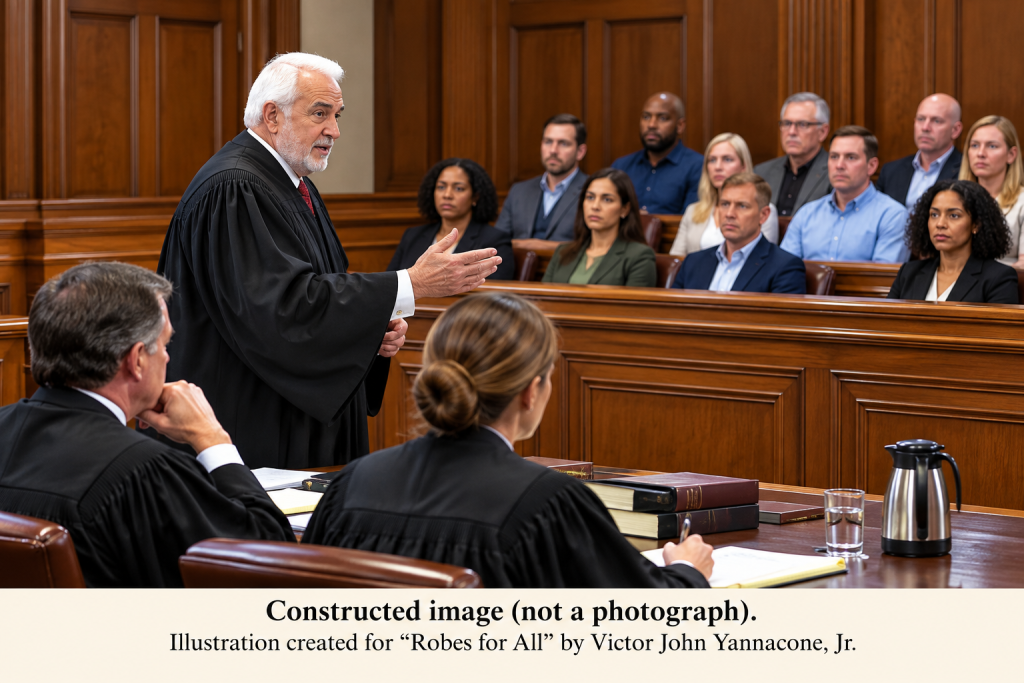
There is a simple solution. Have the attorneys wear black robes in the courtroom.
In 2013, Justice Sandra Day O’Connor wrote that the robe symbolizes that judges are engaged in upholding the Constitution and the rule of law and that they “have a common responsibility.”
But judges do not bear that responsibility alone.
The attorneys who appear before them are officers of the courts in which they practice. They too bear responsibility for the administration of justice and for upholding the Constitution and the rule of law. Prosecutors and defense lawyers, plaintiffs’ lawyers and defendants’ lawyers stand on opposite sides of cases, but they share that professional obligation.
Their clothing should say so. The robe tells everyone in the courtroom what the attorney is, not who they are.
If the common black robe can symbolize the judge’s responsibility to the Constitution and the rule of law, there is no reason it cannot symbolize the responsibility of attorneys to the same principles.
The common black robe has been appropriate for American judges since the founding of the federal judiciary, and there is no reason the same robe is not appropriate for the attorneys trying the case today.
For centuries, the English have put their advocates in robes. For more than two centuries, Americans have put their judges in robes.
The English Inns of Court prescribed sober robes for their members in the sixteenth century. The horsehair wig came later and can remain in England.
Judicial robes are as old as the federal judiciary. The Justices of the Supreme Court appeared together in robes in 1792, and by 1800 the Justices were all wearing plain black robes.
In 1985, the Eleventh Judicial Circuit in Dade County, Florida, required attorneys appearing in jury trials before a circuit judge to wear black judicial robes. The experiment was formally evaluated against jury trials in which attorneys wore ordinary courtroom clothing. Jurors who actually saw the robed attorneys preferred the robes and overwhelmingly considered uniform courtroom dress important. Then, somehow, the American legal profession went back to arguing about what lawyers should wear.
Put every trial attorney before the jury in the same simple black robe. Let the attorneys distinguish themselves by the cases they present, the witnesses they examine and the arguments they make.
Put on the robes and get on with the trial.
Robes for All
September 26, 2026 | The Legal Profession
American judges have been complaining about what lawyers, particularly women, wear in court for decades. Enough already!
There is a simple solution. Have the attorneys wear black robes in the courtroom.
In 2013, Justice Sandra Day O’Connor wrote that the robe symbolizes that judges are engaged in upholding the Constitution and the rule of law and that they “have a common responsibility.”
But judges do not bear that responsibility alone.
The attorneys who appear before them are officers of the courts in which they practice. They too bear responsibility for the administration of justice and for upholding the Constitution and the rule of law. Prosecutors and defense lawyers, plaintiffs’ lawyers and defendants’ lawyers stand on opposite sides of cases, but they share that professional obligation.
Their clothing should say so. The robe tells everyone in the courtroom what the attorney is, not who they are.
If the common black robe can symbolize the judge’s responsibility to the Constitution and the rule of law, there is no reason it cannot symbolize the responsibility of attorneys to the same principles.
The common black robe has been appropriate for American judges since the founding of the federal judiciary, and there is no reason the same robe is not appropriate for the attorneys trying the case today.
For centuries, the English have put their advocates in robes. For more than two centuries, Americans have put their judges in robes.
The English Inns of Court prescribed sober robes for their members in the sixteenth century. The horsehair wig came later and can remain in England.
Judicial robes are as old as the federal judiciary. The Justices of the Supreme Court appeared together in robes in 1792, and by 1800 the Justices were all wearing plain black robes.
In 1985, the Eleventh Judicial Circuit in Dade County, Florida, required attorneys appearing in jury trials before a circuit judge to wear black judicial robes. The experiment was formally evaluated against jury trials in which attorneys wore ordinary courtroom clothing. Jurors who actually saw the robed attorneys preferred the robes and overwhelmingly considered uniform courtroom dress important. Then, somehow, the American legal profession went back to arguing about what lawyers should wear.
Put every trial attorney before the jury in the same simple black robe. Let the attorneys distinguish themselves by the cases they present, the witnesses they examine and the arguments they make.
Put on the robes and get on with the trial.